

Pull up your restaurant’s menu the way a customer actually sees it — the PDF someone taps open at a red light, the laminated card on the table, the page buried two clicks deep on your website. Now pull up your Instagram. For most Bay Area restaurants, those two things barely seem to know each other exist. The menu lives in one world, the marketing lives in another, and the dishes that could be filling your dining room on a dead Tuesday are sitting there as plain text and a price — doing almost none of the work they’re capable of.
Here’s the thing almost every owner misses: your menu is the most powerful marketing asset you own. Not your logo, not your follower count, not the ad budget you don’t have. The menu is the one thing every single customer interacts with, the reason they chose you over the spot next door, and the only part of your business that turns attention into a check. Yet it’s the asset most restaurants market the least.
This is the playbook we use with Bay Area restaurants to turn the menu itself into the engine that fills tables — choosing the dishes worth building a reputation on, designing them to travel on a phone screen, and putting the whole thing on a rhythm your feed can actually follow. No new gimmicks. Just treating what’s already on your menu like the marketing it was always meant to be.
Your menu is a marketing asset, not a price list
Most owners think about the menu exactly twice a year: once when costs creep up and it’s time to nudge prices, and once when something stops selling and gets quietly cut. The rest of the time it just sits there. That’s the mistake. A menu isn’t a spreadsheet of what you serve — it’s a list of reasons people might cross a bridge to come see you.
Every dish is a potential hook, and you’re sitting on dozens. The short rib that takes three days. The dumplings folded by hand every morning. The seasonal salad that only shows up when the farmers’ market does. Each one is a story, a photo, and a reason to post — and a reason for someone scrolling in the Inner Sunset to decide tonight’s the night. When you stop seeing the menu as inventory and start seeing it as content, you never run out of things to say.
The restaurants winning on social in the Bay Area aren’t the ones with the biggest budgets. They’re the ones who realized the marketing was already on the plate. The rest of this playbook is about getting it off the plate and in front of people.
Find the one dish worth building a reputation on
Before you market the whole menu, you need a hero. Every memorable Bay Area restaurant has one dish that does outsized work — the thing people describe to their friends, the plate that shows up in every review, the order a regular brings every out-of-towner to try. If you can’t name yours in one breath, that’s the first job.
Your hero dish is the one you’d put on a billboard, not necessarily the one with the best margin. Those are sometimes the same plate, but don’t confuse them. The hero is whatever makes someone stop scrolling and think “I need that.” Maybe it’s a towering fried chicken sandwich in Oakland, a tangle of garlic noodles in the Outer Richmond, a wood-fired pizza up in Napa with char you can see from across the room. It earns its spot by being crave-worthy and unmistakably yours.
Once you’ve named it, lean in hard. Most owners spread their attention evenly across forty menu items and wonder why nothing lands. Pick the one and give it ten times the airtime. Shoot it weekly from new angles, put it first in your highlights, mention it by name when you reply to DMs. Repetition is what turns a good dish into a destination — and a destination is what fills a Wednesday in the Mission when nobody else planned to go out.
Design your best dishes for the camera, not just the palate
A dish can be delicious and completely forgettable on a screen. The plates that travel — the ones that get screenshotted, saved, and sent straight into a friend’s DMs — share a handful of visual traits, and you can build for them on purpose.
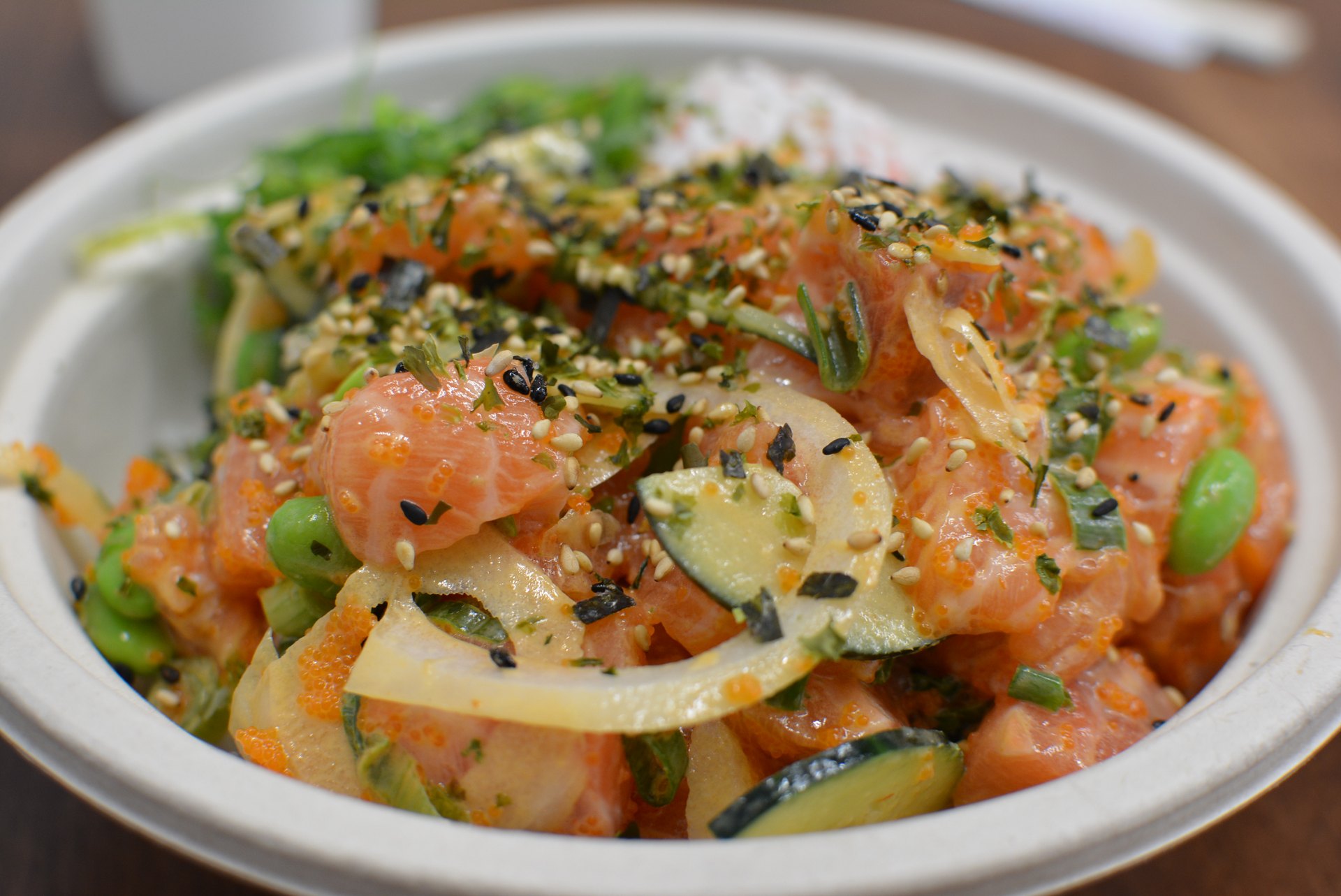
Color and contrast do the heavy lifting. A monochrome bowl of beige disappears in the feed no matter how good it tastes. But a salmon poke bowl piled with bright fish, green edamame, and a scatter of tobiko and sesame against a clean white bowl? That stops a thumb cold. You don’t have to reinvent the dish — a handful of scallions, a vivid sauce, a wedge of citrus can be the difference between a plate that gets posted and one that gets ignored.
Drama and motion give people something to watch. Height, steam, a cheese pull, the pour of a broth tableside, the crack of a crème brûlée — these are the moments built for a three-second Reel. If a dish has a moment like that baked in, you’ve got a video every time you fire it. If it doesn’t, ask your kitchen whether a small change in plating could add one. You’re not cooking for the camera instead of the guest — you’re making sure the first impression online matches the one at the table.
Turn specials and limited drops into an urgency engine
A permanent menu is a standing invitation — come whenever. That’s exactly why it doesn’t move anyone to come now. Urgency is what converts a vague “we should go there sometime” into a booked table this weekend, and the cleanest way to manufacture urgency honestly is the limited-time offer.
If it’s only here for a little while, people show up. A Dungeness crab special that runs while the season’s good. A dumpling collaboration with the spot down the street for one weekend only. A dessert that disappears at the end of the month. The scarcity is real, so the marketing writes itself — and the post has a built-in reason to act instead of bookmark. We’ve watched a single “last weekend for this” Story fill a slow Sunday in Hayes Valley that no amount of evergreen posting would have touched.
Give every drop a name, a window, and a deadline. “Truffle season menu, through the end of February” beats “new specials” every time, because it tells people exactly what they’ll miss and exactly when. Announce it before it launches, remind people in the middle of the run, and post a real last call near the end. Three posts, one dish, and a deadline doing the persuading for you.
Merchandise the menu like a store, not a spreadsheet
Walk into any well-run shop and nothing is accidental — the bestseller is at eye level, the high-margin item has the nicest sign, the thing they want to move is the first thing you see. Your menu deserves the same intention, both on the page and in your marketing.
Tell people what to order; don’t make them guess. Choice is paralyzing, and a guest staring at fifty options often defaults to the safe, cheap thing — or doesn’t book at all. “First time here? Start with these three” is some of the highest-performing content a restaurant can post, because it removes the work. It also quietly steers people toward the dishes you most want them ordering: the ones with the best margin and the best photo.
Words sell food before forks do. “Crispy pork belly” is fine. “Twice-cooked pork belly, lacquered and crackling, over chili-black-vinegar greens” makes someone hungry just reading it. You don’t need purple prose on every line, but your signature dishes deserve descriptions that do them justice — on the menu, in the caption, and in the reply you send when someone asks what they should get. The Peninsula crowd researching dinner in Palo Alto is reading every word before they book.
Put the menu on a seasonal rhythm the feed can follow
One of the quiet advantages of running a restaurant in the Bay Area is that the calendar does half your marketing planning for you. Produce changes, seasons turn, and the region practically expects menus to move with them — and every change is a reason to post that doesn’t feel like an ad.
Let the seasons set your content calendar. Spring asparagus and peas, summer stone fruit and tomatoes from the farmers’ market, fall squash and the first rainy-day braises, Dungeness crab when winter hits — each shift is a natural launch moment. Build your posting rhythm around the menu’s own cycle and you’ll rarely stare at a blank caption again. The dish changes, the story changes, and the feed stays alive with almost no extra invention.
Tie the menu to the moments your neighborhood already cares about. Dungeness season along the Embarcadero, tomato peak up in Sonoma, the holiday-party stretch when every SoMa office is hunting for a group dinner. When your menu marketing lines up with what people are already thinking about, you’re not interrupting their scroll — you’re answering a question they already had.
Connect the crave to the booked table
None of this matters if a craving has nowhere to go. The most common failure we see isn’t bad menu content — it’s gorgeous food posts that dead-end, leaving someone hungry with no obvious next step. Every dish you market needs a clear, short path to a table.
Make the next step obvious every single time. The post that shows the dish should also tell people how to get it: reserve through the link in your bio, DM the word “table” to book, or walk in tonight before it’s gone. Don’t assume people will go hunting — the diner in the Marina deciding between you and three other spots will go with whoever made the decision easiest. A great photo earns the attention; a clear next step turns it into a cover.
Watch which dishes actually drive bookings, then double down. Pay attention to what happens after you post. Which dish floods your DMs? Which special spikes reservations on the Peninsula? Which photo gets sent to a friend instead of just liked? That’s your real menu-marketing data, and it beats any follower count. Find the two or three plates that consistently move people from screen to seat, and give them even more of the spotlight. The menu will tell you what’s working if you’re watching the right numbers.
Your menu is already full of reasons for people to choose you — the trick is making sure those reasons leave the kitchen and land in front of the right person at the right moment. If you’d rather spend your nights running your restaurant than planning content calendars and shooting hero dishes between covers, that’s exactly what we do. Get in touch with Metaroots and we’ll help you turn your menu into a marketing engine that keeps Bay Area tables full — from the Marina to the South Bay and everywhere in between.