

Watch a Bay Area restaurant owner make a post and you’ll see the same time split every time. Forty minutes on the food. Ten minutes moving the plate around to find the light. Four seconds on the caption, thumbed out at the host stand: “Delicious 😋 #sfeats #bayareafood.”
That photo did an enormous amount of work. The caption threw most of it away.
Captions are the most neglected asset in restaurant marketing, and it’s easy to see why. They feel like the packaging, not the product. But the caption is the only part of a post that can name a night, name a neighborhood, name a person, and ask for something. It’s also the only part you can fix in thirty seconds without reshooting anything. This is the playbook for writing captions that do actual work — the kind that turn a scroll into a table on Thursday.
The Photo Stops the Scroll. The Caption Decides What Happens Next.
These are two different jobs and they do not substitute for each other. A great photo buys you about a second and a half of attention. That’s the entire purchase. What happens in that second and a half — whether someone keeps scrolling, saves the post, sends it to a friend, or opens your profile looking for hours — is decided almost entirely by words.
Here’s the test that makes this obvious. Take your last twenty posts. Cover the photos with your hand and read only the captions. How many of them would make a stranger in the Outer Richmond do anything at all? Most owners who run this exercise find that eighteen of the twenty are narration — a description of a thing the reader can already see, followed by hashtags.
Narration is the default failure mode, and it’s not laziness. It’s that nobody ever told you the caption had a job. Once it has one, the writing gets dramatically easier.
For Most Readers, the First Line Is the Whole Caption
Instagram cuts your caption off after roughly 125 characters in the feed and hides the rest behind “more.” The overwhelming majority of people never tap it. Which means the paragraph you carefully wrote about your grandmother’s recipe is, functionally, invisible — unless the first line earned the tap.
Front-load ruthlessly. Everything that matters goes first. “We’re so excited to announce that starting this Friday we’ll be running a special on oysters” wastes the entire visible window on throat-clearing. “Friday: dollar oysters until we run out” says the same thing and leaves room to breathe.
Ban your opening crutches. Most restaurants open captions the same four ways forever: the dish name, “Our famous ___,” “Happy Monday!” and “We’re excited to announce.” All four are dead on arrival because they tell the reader nothing they didn’t already know from the picture. If your last ten captions all start the same way, that’s a pattern your regulars have learned to scroll past.
Write the first line last. Draft the whole caption, then find the most interesting sentence in it and move that sentence to the top. It’s almost never the one you started with. The good line is usually buried in the middle, where you relaxed.
Stop Describing the Dish — The Photo Already Did That
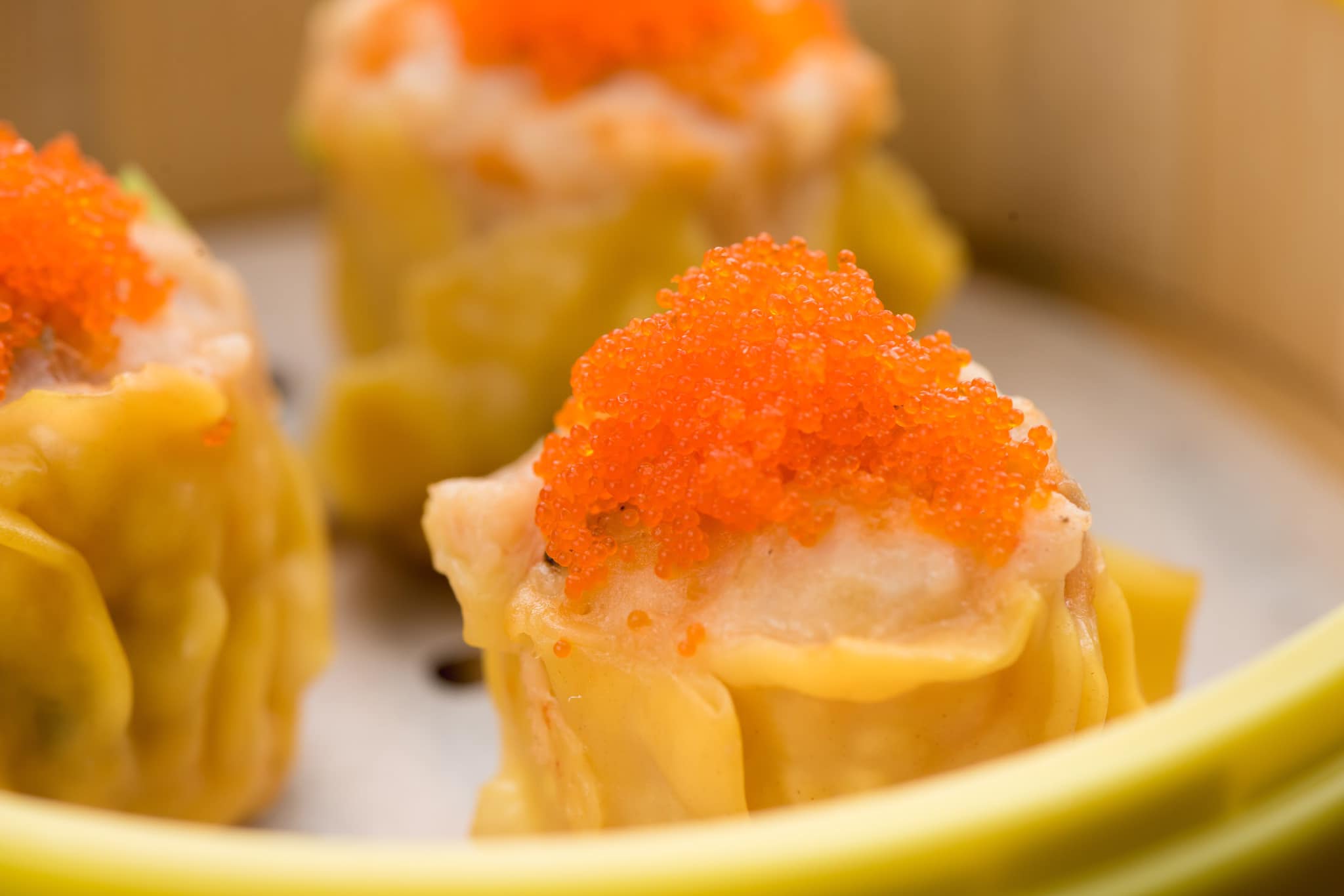
A photo of shrimp and pork siu mai topped with roe, captioned “our delicious siu mai 🥟,” contains exactly zero information the image didn’t already deliver. You paid for that real estate twice and used it once.
The caption’s opportunity is everything the camera physically cannot capture. How it’s made. Who makes it. How long it takes. When it’s available. What it costs you to keep on the menu. What to order alongside it. Why it exists at all.
Compare the two versions. “Shrimp and pork siu mai 🥟 #dimsum” tells a reader nothing. “Six hundred of these get folded by hand before we open. When the last steamer goes out around two, that’s it until tomorrow” tells them it’s handmade, tells them it’s finite, and quietly tells them to come early. Same photo. One of those captions creates urgency and one fills space.
Sensory language still works, but only where the photo is blind. A picture can’t carry temperature, sound, or smell. “You hear this one before you see it” is a legitimate line for a sizzling platter because the image genuinely cannot do that job. “Golden, crispy, delicious” is not, because the photo already said all three, louder.
Specific numbers beat every adjective you own. “Slow-braised for hours” is marketing. “In the pot at 6am, off at 2pm” is a fact, and facts are what people repeat to their friends. The same is true of “we go through forty pounds of Dungeness on a good Saturday” or “this recipe hasn’t changed since 1998.” Nobody screenshots an adjective.
Give Every Caption Exactly One Job
There are really only four things a restaurant caption can do well. It can sell a specific dish. It can drive a specific action, like booking a table or ordering pickup. It can build the story of the place and the people in it. Or it can start a conversation that gets people commenting.
The problem is that most captions attempt all four in six lines and accomplish none. They describe the dish, then mention the new hours, then thank the community, then ask a question, then push the reservation link. That’s not a caption, that’s a newsletter, and the reader bails somewhere around the third pivot.
Decide the job before you type a word. If today’s post is selling the Friday crab special, then it sells the Friday crab special and nothing else. The new patio furniture can have its own post on Tuesday. Restraint is what makes a caption feel confident instead of desperate.
Balance the jobs across the month, not within a post. A feed where every single caption is selling something reads like an ad account, and people mute ad accounts. A rough working split is half of your posts selling a dish or an occasion, a quarter telling the story of the kitchen and the crew, and a quarter genuinely built to get replies. The selling posts work because the other half earned the goodwill.
Write Like a Server, Not Like a Brand
Here’s the fastest editing tool in this entire post. Read your caption out loud and ask whether a server could say it to a four-top without everyone at the table wincing.
“Indulge in our exquisite culinary offerings crafted with the finest seasonal ingredients” fails instantly. No human has ever said that in a dining room. “Get the crab. Everyone gets the crab. I’m not going to pretend otherwise” passes, because it’s how an actual person recommends an actual dish.
Bay Area diners are unusually allergic to marketing language. This is a region where people will drive from the Peninsula to the Inner Sunset for a specific bowl of noodles and read three Reddit threads before deciding. That audience has a very fast filter for anything that sounds like it came out of a brand deck. Sounding like a person isn’t a stylistic preference here — it’s a credibility requirement.
Names are the cheapest specificity you can buy. “Our chef” is a category. “Auntie Mei, who’s been folding these since we opened” is a person, and people are memorable in a way that job titles never are. The same goes for your regulars, your farmers, your fish guy, the neighbor who’s been sitting at the same corner table since the Mission had parking.
Let the punctuation be casual. Short sentences. Fragments where they land. The occasional one-word line for rhythm. Captions that read like a press release get skimmed; captions that read like a text from a friend get finished.
Make the Ask You’ve Been Too Polite to Make
Most restaurant captions end in a hashtag pile. A few end in “link in bio.” Almost none end in a direct, specific, low-friction request, which is strange, because asking is the entire reason the post exists.
One ask, stated plainly. “Save this for Friday.” “Send this to whoever owes you dinner.” “Call us for anything over eight people.” “Come before seven and you’ll get a table.” Each of those is a single instruction a person can follow in one motion without leaving the app or thinking hard.
Saves and shares are worth more than likes, so ask for those. A like is a reflex. A save is somebody filing your restaurant away as a plan, and a share is a personal recommendation with your name on it. Both also tell the algorithm the post was worth something, which is how a Tuesday post about braised short rib ends up in front of somebody in Millbrae who’s never heard of you.
Match the ask to the job. A storytelling post about the crew shouldn’t end in a hard reservation push — it should end in something that invites a reply. A Friday special post should absolutely end in “we’re taking calls now.” Mismatched asks are what make a caption feel like it was assembled rather than written.
Build a Caption Bank So You Never Start From Zero
The real reason restaurant captions are bad has nothing to do with writing ability. It’s that they get written at 9:40 on a weeknight, on a cracked phone, by somebody who has been on their feet for eleven hours. Nobody writes well in that state. So stop asking yourself to.
Batch the words the same way you batch the photos. Sit down once a month with coffee and write fifteen captions in one go. Writing in a batch is faster per caption and better per caption, because you can see them side by side and catch yourself opening three of them the same way.
Keep a facts file, not a template file. Templates produce captions that sound like templates. What you actually want is a running document of true, specific things about your restaurant: how early the prep crew arrives, how many pounds of anything you go through in a weekend, who taught the chef the recipe, what year the sign went up, which dish the staff eats on their break. Good captions are almost always a fact plus an ask. The facts are the hard part, and you only have to collect them once.
Mine your own winners. Every quarter, pull your five best-performing posts and read the captions closely. There’s usually an obvious pattern — a question format, a scarcity line, a particular kind of opening. That pattern is your audience telling you what they respond to, which is far better information than anything a general social media guide can offer you.
What to Do This Week
Start with the audit, because it costs nothing and it’s clarifying in a way that’s slightly painful. Open your grid, cover the images, and read twenty captions in a row with fresh eyes. Count how many contain a single fact a stranger couldn’t have guessed from the photo, and how many make any request at all. That number is your baseline.
Then rewrite three of them. Not the whole feed — three. Take your three best-performing photos, give each caption one job, open with the most interesting true sentence you can find, and end with one plain ask. Post them over the next two weeks and watch what saves and shares do. It’s a small enough experiment that you’ll actually finish it, and the results tend to settle the argument fast.
The photo gets someone to stop. The caption is what turns stopping into showing up — and it’s the half of the equation you can rewrite tonight for free.
If writing fifteen captions a month is the thing that keeps not happening, that’s usually a capacity problem rather than a talent problem, and it’s the kind of thing we handle every day for restaurants across San Francisco, the Peninsula, and the East Bay. Get in touch with Metaroots and we’ll take the whole content operation off your plate — photos, captions, posting, all of it — so the words in front of your food are finally doing as much work as the food itself.